Trouser twill map: chino, drill, and gabardine by weight and weave
Short answer
Cotton trousers are mostly one weave — twill — sorted into three families by yarn and weight. Chino cloth runs 8-11 oz and breaks in fastest; drill runs 10-14 oz and wears hardest; gabardine uses finer, denser yarns around 9-11 oz for a smooth, dress-leaning face. Nine to twelve oz is the all-purpose band for everyday trousers. The weave gives all three their durability; the weight decides whether the trouser reads smart, casual, or workwear.
What twill does for trousers
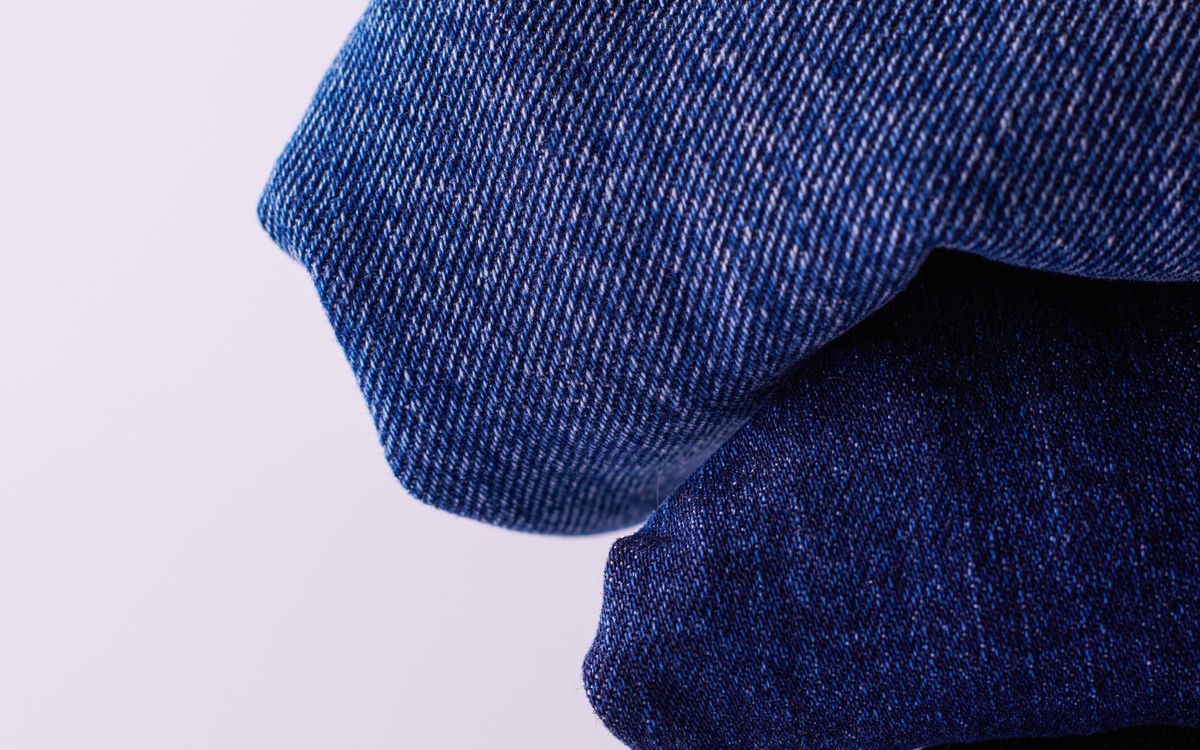
Twill is the weave where each weft yarn passes over and under warp yarns in a staggered pattern, leaving the diagonal lines — the wale — that give denim, chinos, and drill their shared texture. Two properties make it the default trouser weave. First, strength: fewer interlacings per area than a plain weave means the yarns carry load more independently, so a twill of the same weight resists abrasion better. Second, drape: those same floats let the fabric bend, which is why a 10 oz twill trouser walks more easily than a 10 oz canvas one built in plain weave. The mechanics behind this sit in the weave families guide, which covers how twill, plain, and satin weaves distribute the same fiber mass differently.
The diagonal structure has a third, quieter consequence: twill shows wear asymmetrically. The warp-faced side takes the abrasion, so seat and thigh wear appears as a slow shift in surface texture rather than an instant hole — the same behavior that gives raw denim its fades, and the reason the selvedge denim weight guide reads like a special case of this map.
The three families at a glance
The names are garment-history terms rather than strict fabric categories, and they overlap in the middle weights. Still, each family has a recognizable center of gravity:
| Family | Typical weight | Yarn and density | Character | Leans |
|---|---|---|---|---|
| Chino | 8-11 oz | Medium yarns, moderately open twill | Smooth, softens quickly, creases gently | Smart-casual |
| Drill | 10-14 oz | Thicker yarns, dense twill | Firm, textured, extremely abrasion-resistant | Workwear |
| Gabardine | 9-11 oz | Fine yarns, steep tight twill | Dense, smooth face, crisp crease | Tailored |
Chino cloth descends from military uniform cloth of the late nineteenth century, cut today into the everyday cotton trouser most people own. Drill — the name likely traces to the same root as “three,” for the three-harness twill it originally used — is the heavier ancestor kept alive by workwear. Gabardine, patented as a tightly woven steep twill, is the finest-yarned of the three and survives mostly in tailoring, in both wool and cotton versions.
Chino: the 8-11 oz everyday band
Chino cloth is defined by balance. Medium yarns in a moderately dense twill give it enough body to fall straight from the hip and enough softness to stop reading as uniform after a month of wear. At 8-9 oz the fabric drapes closer to the leg and suits warmer weather and slimmer cuts; at 10-11 oz it stands off the body slightly, holds a cuff, and survives daily wear for years. The full weight breakdown for this style, including the stretch-blend versions that dominate retail now, sits in the chinos fabric-weight guide.
Two construction details predict how a chino ages better than its weight does. Ring-spun, combed yarn pills less and smooths faster than open-end yarn at the same weight — the same yarn rule that separates a good tee from a cheap one. And garment washing before the trouser ships removes most of the first-wash shrinkage, which for untreated cotton twill can run a few percent in both directions. An unwashed 10 oz chino that shrinks 3% loses real length and tightens across the seat; the pre-washed equivalent fits the same after a year as on day one.
Drill: the heavy end of the map
Drill is what the chino families look like when weight is the priority. Thick yarns in a dense twill produce a fabric that starts stiff, creases broadly rather than sharply, and resists abrasion at a level the lighter twills cannot match — which is why work trousers, some uniforms, and most canvas-adjacent cotton bottoms live here. Ten to twelve oz is the wearable everyday edge of the family; above 14 oz the fabric behaves closer to canvas and needs a season of break-in.
Drill also carries one construction note worth reading listings for: it is frequently sold either unbleached and undyed (“drill” in its rawest form) or dyed with heavy pigment finishes that fade at the seams and folds within weeks. Neither is a defect — the fading is the pigment sitting on the yarn surface rather than in the fiber — but buyers who want uniform color for years should look for yarn-dyed or piece-dyed labels rather than heavily pigmented finishes.
Gabardine: fine yarns, tight twill
Gabardine earns its separate name from construction rather than weight. Where chino and drill space medium or thick yarns in a conventional twill angle, gabardine packs fine yarns into a steep, dense twill, producing a smooth face with a fine diagonal and a distinctive crispness. At a similar weight to a chino — usually 9-11 oz in cotton, lighter in worsted wool versions — it creases sharply, resists wrinkling better, and reads dressier on the leg.
The trade is behavior after wear. The dense weave that makes gabardine crisp also makes it slower to soften, and the tight diagonal shows shine at seat and knee earlier than a looser twill of the same weight, because the flattened surface reflects light once the yarns abrade. For trousers worn daily, chino cloth outlasts it in appearance; for trousers worn on occasions, gabardine holds a line nothing else in the cotton twill range matches.
Matching weight to season and use
Weight maps onto season roughly as it does across other cotton categories, with the twill-specific wrinkle that heavier twills warm faster than plain weaves of the same oz:
| Use | Weight band | Family fit |
|---|---|---|
| Hot weather, relaxed cuts | 7-9 oz | Light chino, unwashed finish |
| Everyday, three seasons | 9-12 oz | Chino or midweight drill |
| Tailored, occasion wear | 9-11 oz | Gabardine, wool or cotton |
| Field and work use | 12-14 oz | Heavy drill |
The seasonal logic has the same cotton ceiling as everywhere else: a 13 oz drill trouser blocks wind well but insulates no better per gram than lighter cotton, and genuine cold still belongs to wool layers underneath or wool trousers instead.
Reading a trouser listing
The lines that separate a reliable listing from a vague one: fabric weight in oz or gsm, the twill family or fabric name, yarn quality (ring-spun, combed, or silent), stretch content as a percentage (one to three percent elastane changes fit more than one ounce of weight does), and wash treatment. Weight plus any two of the others allows a real comparison. A listing that offers only “premium stretch twill” offers nothing — the stretch share and the yarn type are doing the work the adjective claims to do.
The same spec-first reading carries over to other weight-graded bottoms, and the broader gsm map across fabric classes places these twills against knits and wovens of equivalent mass — where the 10 oz twill that feels substantial as a trouser reappears as barely-midweight canvas territory. For the twill that gets its own cult, the raw-denim weight guide covers the 12-16 oz band, and the same warp-abrasion behavior appears there as deliberate fade culture rather than ordinary wear.
Frequently asked questions
- What weight fabric is best for trousers?
- Nine to twelve ounces per square yard covers most cotton trouser use — opaque, structured enough to fall cleanly from the hip, light enough to move in. Below 8 oz suits hot weather and drapier cuts; above 12 oz the fabric reads workwear and softens over months rather than weeks.
- Are chinos and drill the same thing?
- Both are cotton twills and they overlap at the middle weights, but drill is traditionally a heavier, denser twill built for workwear, while chino refers to a garment style usually cut from a lighter, smoother twill. A 12 oz chino approaches drill territory; a 9 oz drill-style trouser behaves like a heavy chino.
- Why does gabardine feel smoother than chino cloth?
- Gabardine is woven with finer yarns at a steeper twill angle and higher density, producing a tight, almost ribbed diagonal and a smooth face. Chino cloth uses plainer yarns in a more open twill, which is why it breaks in softer and creases less crisply.