Linen weight classes: what separates a handkerchief from a canvas
Linen is one of the few fabrics whose weight range runs from something thin enough to read through to something stiff enough to upholster a chair. All of it comes from the same flax plant, and the difference between a summer shirt and a canvas tote is almost entirely how much fiber got packed into the weave. Reading that figure — and knowing what each band behaves like — is the whole skill of buying linen online.
Short answer
Linen divides cleanly by weight: roughly 100 to 130 gsm is handkerchief and sheer-blouse territory, 130 to 180 gsm is standard shirting, 180 to 250 gsm carries dresses and trousers, 250 to 350 gsm handles aprons and heavy workwear, and above 350 gsm the cloth is canvas-class upholstery and bag material. The heavier the cloth, the more structure and the less drape, and the longer the softening arc through washing. A linen listing without a stated weight is guessing; the class bands let you narrow it from the garment type alone.
Why linen weight is worth reading
Flax is a bast fiber — it comes from the stem of the plant rather than a seed pod, and its fiber bundles are long, stiff, and relatively inextensible. That construction gives linen its signature behaviors at every weight: high tensile strength, low stretch, fast moisture transfer, and a crease that sets rather than springs back. It also means weight changes the character of the cloth more dramatically than it does in cotton. A light cotton and a heavy cotton still read as the same material; a 120 gsm linen and a 300 gsm linen barely resemble each other, one falling into liquid folds and the other holding a pressed edge. Because the spread is so wide, the weight figure on a linen listing tells you more about the garment than almost any other spec printed on the page.
| Weight class | Typical gsm | Where it lives |
|---|---|---|
| Sheer | 100 - 130 | Handkerchiefs, linings, sheer blouses, scarf cloth |
| Shirting | 130 - 180 | Shirts, blouses, summer dresses |
| Mid-weight | 180 - 250 | Trousers, structured dresses, table linen |
| Heavy | 250 - 350 | Aprons, workwear, bedspreads, heavy trousers |
| Canvas class | 350 and up | Upholstery, totes, sails, wall hangings |
The classes overlap at the edges by design — a 250 gsm cloth can be either a stiff trouser or a light apron depending on the finish — but the ladder itself is stable across the linen trade.
Shirting linen: the 130 to 180 band
Standard shirt linen sits in the same weight neighborhood as everyday cotton shirting, and it behaves like a crisper, more open version of it. At the lighter end, around 130 to 150 gsm, the cloth is semi-sheer in bright light, wrinkles into fine soft creases, and blows in any wind — the classic Italian summer shirt. Toward 180 gsm it gains opacity and a bit of body, holds a collar shape without fusing, and starts to crease more boldly. Across the whole band the weave is usually a plain one, because flax’s low stretch makes open plain weaves stable where cotton would need more interlacing to hold together. This is also the band where seasonal fit matters most: the same shirt pattern in 140 gsm and 180 gsm wears like two different garments in a warm climate.
Mid-weights: dresses, trousers, and table linen
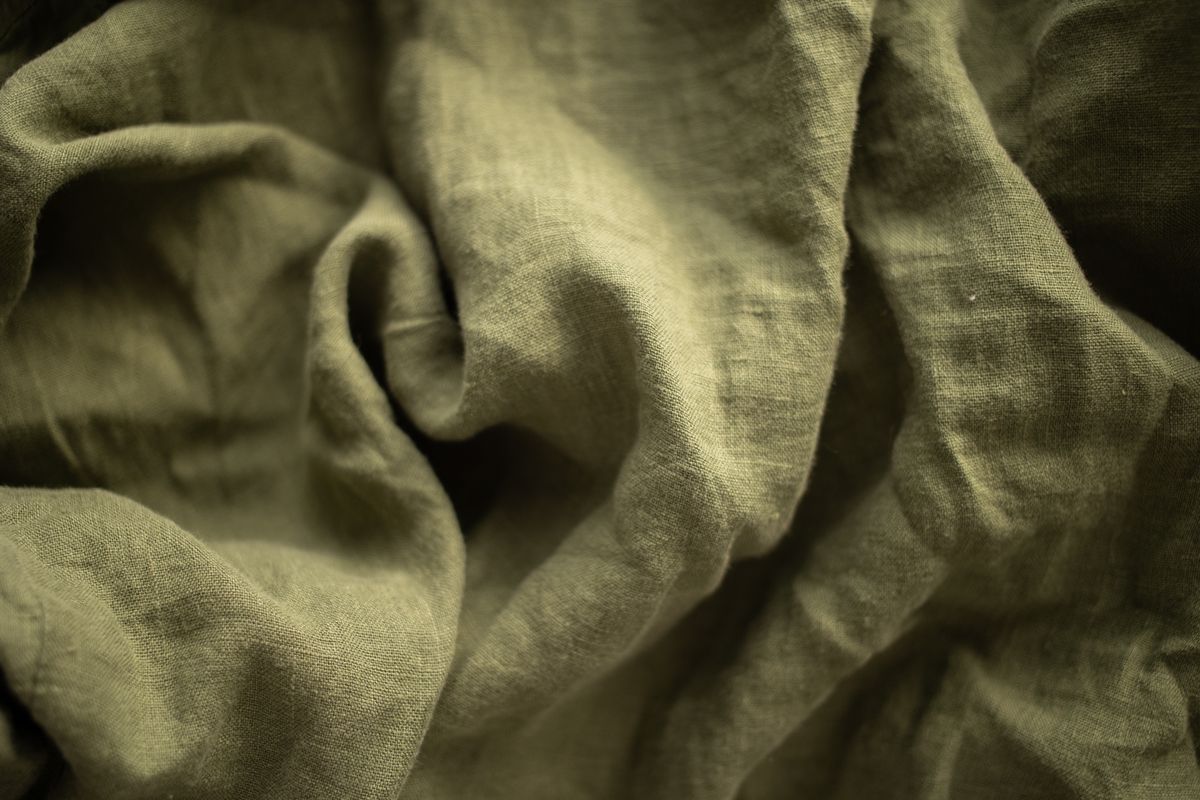
From roughly 180 to 250 gsm, linen stops draping onto the body and starts standing slightly away from it. This is trouser linen — cloth with enough substance to hold a pressed crease through a day of wear without collapsing at the knee — and it is the weight class of most European household linen too, since tablecloths and napkins want exactly that balance of body and absorbency. Structured dresses live here as well: the weight lets a linen dress hold an A-line shape that a shirting-weight version would lose. On the body, mid-weight linen feels dense and dry in the hand, and its creases are broader and more architectural than the fine wrinkles of shirt cloth.
Heavy linen and canvas class
Above 250 gsm the cloth crosses into workwear and furnishing territory. Aprons, chef’s linen, and heavy-duty trousers sit in the 250 to 350 band, where the weave is tight enough to block wind and resist abrasion at the scale of jobs rather than outfits. Past roughly 350 gsm the material is functionally canvas: bag bodies, upholstery, and historically sails, where flax’s tensile strength was the entire point. Few apparel listings venture into this band, and when they do, the garment usually borrows its design language from workwear — heavy aprons, chore coats, market totes. A buyer holding a “heavyweight linen shirt” listing that never states a weight should be skeptical: real canvas-class cloth makes a shirt that stands on its own on the floor, which is generally not what the product photos show.
How weight changes drape and the softening arc
Every linen softens with washing, but weight decides how far the journey runs and how long it takes. Light shirting cloth arrives already fairly supple and softens toward a fluid, almost worn-in hand within ten or fifteen washes, as the pectin binding between flax fiber bundles breaks down and the bundles split into finer filaments. Heavy cloth starts rigid and softens into something closer to waxed canvas softened by oil — it gains flexibility but never approaches drape, because sheer mass resists bending no matter what the fiber state. Two practical consequences follow. Mid-weight trousers soften usefully over their first months, while a canvas-class apron mostly just relaxes at the fold points. And since the softening arc runs through laundering rather than wear, drying method shapes the result as much as washing does.
Reading a linen listing
Linen listings state their weight less often than cotton ones, which makes the class bands the main tool for filling the gap. A shirt without a stated gsm is near-certainly in the 130 to 180 band, because nothing heavier presses acceptably into a shirt pattern; a “tote” or “upholstery-weight” claim without a number can be assumed past 350 gsm. Where a figure does appear, check the unit before comparing anything, because the three conventions in circulation produce very different numbers for the same cloth:
| Unit quoted | Example figure | What it means in gsm |
|---|---|---|
| gsm | 180 gsm | 180, directly |
| Ounces per square yard | 5.3 oz | Roughly 180 |
| Ounces per linear yard, 58-inch cloth | 7 oz | Roughly 150 |
The linear-yard unit is the trap: it weighs one running yard of the full piece rather than a fixed area, so the gsm equivalent depends on the cloth width, and suiting-style figures of 7 or 9 oz describe cloth far lighter per square metre than a cotton buyer would assume. The general gsm map puts linen in context against cotton and wool at the same weights, and it is worth a read before trusting any single-number comparison across fibers.
Frequently asked questions
- What gsm is typical linen shirting?
- Most linen shirt fabric falls between roughly 130 and 180 gsm. Below that the cloth turns sheer and collapses into soft wrinkles; above roughly 200 gsm it gains the body of trousers-weight cloth and starts to stand away from the body instead of draping onto it.
- Why does linen soften after washing?
- Flax fibers carry pectin and other binding compounds between them, and the fiber bundles in new cloth are stiff. Washing gradually breaks the bundles into finer filaments and relaxes the residual stiffness, so the cloth gets progressively more supple and creases more softly over its first dozen washes.
- Do linen weights convert to ounces like cotton?
- The arithmetic is the same, since gsm and ounces per square yard describe any fabric. Roughly, 140 gsm is about 4.1 oz, 180 gsm about 5.3 oz, and 280 gsm about 8.3 oz. The catch is that some linen, especially suiting and workwear cloth, is quoted per linear yard of full width, which is a different unit.