Leather belt grades: full-grain, top-grain, and the label that hides the cut
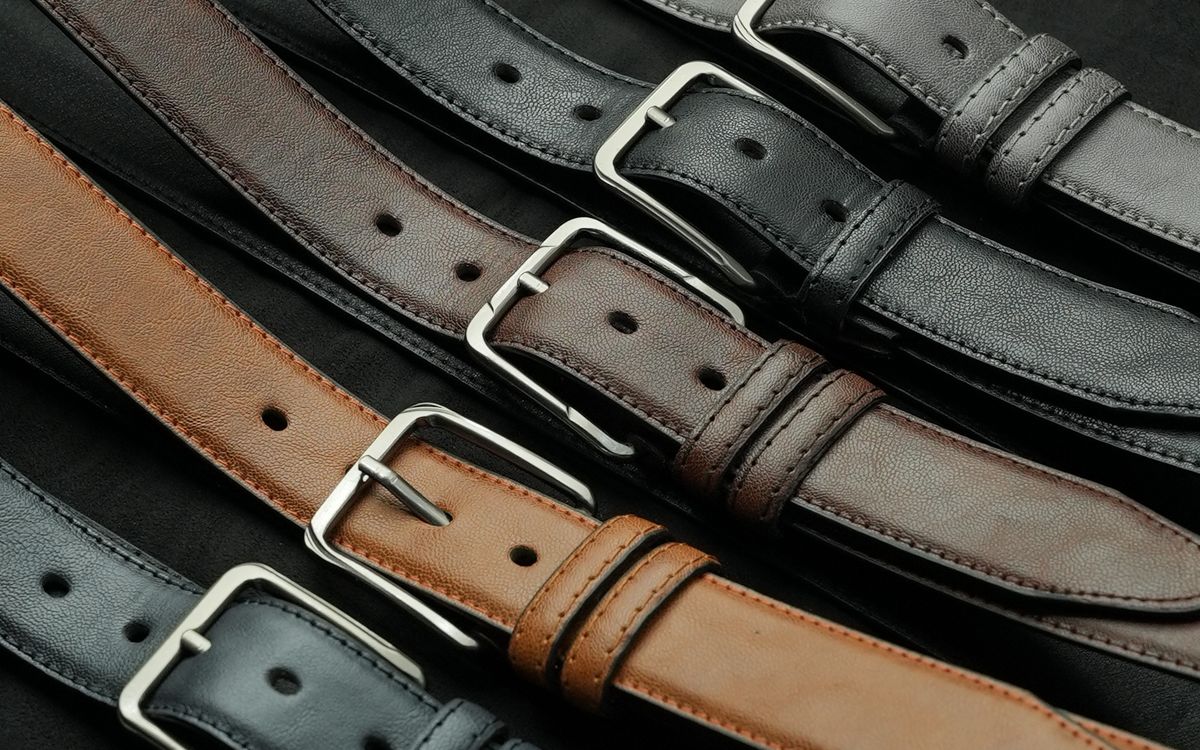
A belt is one of the few accessories where the leather grade is the whole product: there is no fabric lining, no padding, nothing between the label and the strap. That makes belt labels unusually honest by accident — the grade word printed on the tag is almost always the cut of leather you are holding. This guide walks through what full-grain, top-grain, and “genuine leather” actually mean in trade practice, how tanning changes how a strap ages, and how to read width, thickness, and hardware the same way a saddler would.
Short answer
Buy full-grain if you want a strap that stiffens, burnishes, and darkens with wear; buy top-grain if you want a uniform, factory-smooth look and accept less aging character. Treat “genuine leather” on a belt as the budget cut, not a quality mark — it is real leather, but the leftover corium after the top layers are split away. Then check three things the label rarely volunteers: vegetable versus chrome tanning, strap thickness in ounces or millimeters, and whether the buckle is solid metal or plating over pot metal.
The three grades, read from the hide
All belt leather comes from the same cross-section. A hide has two working layers: the grain — the dense, tightly woven outermost surface that carried the hair — and the corium beneath it, the looser fiber structure that gives leather its body. Grade names describe how much of that cross-section survives tanning:
| Grade | What happens to the hide | Wear behavior on a belt |
|---|---|---|
| Full-grain | Only the hair is removed; the grain surface stays intact, scars and all | Strongest cut; stretches slightly, burnishes, develops patina; surface marks are permanent character |
| Top-grain | The grain is sanded or lightly buffed to remove blemishes, then sealed or embossed | Uniform appearance; slightly less strong; sealed finish resists stains but peels or looks flat as it ages |
| Genuine leather | The corium left after the top layers are split off; often corrected and embossed with an artificial grain | Softest and weakest cut; creases rather than burnishes; the failure mode is surface cracking and peeling |
| Bonded | Leather scraps ground up and laminated with adhesive | Not a cut of leather at all; the lowest tier, prone to delaminating at the flex points |
Two consequences follow from this ladder. First, full-grain is the only grade whose surface is untouched, which is why it is the only one that patinas — the darkening and polishing you see on an old strap is the intact grain itself being burnished by wear. Second, the grades above are a completeness ranking, not a softness ranking: full-grain from a firm steerhide starts stiffer than a genuine-leather strap, and that initial stiffness is exactly the strength showing.
Full-grain: what the intact grain buys you
The grain layer is the densest fiber structure in the hide — fibers interweave tightly at the surface and loosen progressively into the corium. Leaving it intact buys three things. Strength: the surface resists tearing and abrasion better than any sanded-and-resealed finish, which is why work belts and carry belts are specified in full-grain as a matter of course. Aging: an untouched grain burnishes at the buckle crease and around the holes, turning a matte strap glossy at exactly the points your hands and trousers touch most. Breathability: an intact, unsealed grain still transmits moisture, so the strap sweats less against the waistband than a heavily finished one.
The trade-offs are visible on day one. Full-grain shows the hide: insect bites, brand marks, and range scars stay on the surface, so straps cut from it are either sorted for clean hides or sold with their marks as character. The strap also starts rigid — a stiff full-grain belt needs a week or two of wear before it rolls comfortably through the loops. Buyers who want a perfect, identical surface on day one are better served by the middle of the ladder, and brands know it.
Top-grain and “genuine leather”: the middle of the ladder
Top-grain is the workhorse of the mid-market. Sanding the grain removes blemishes, and the corrected surface is then sealed with pigment and embossed with an artificial grain pattern. The result is a strap that looks flawless and consistent across hundreds of units, resists staining, and cleans with a damp cloth — genuine advantages for a dress belt that must look identical every day. What is lost is strength margin and aging: the sanded surface has less fiber integrity at exactly the layer that takes the flex, and the sealed finish cracks or clouds rather than burnishes. A top-grain belt does not get better with wear; it gets older.
“Genuine leather” is the term doing the most work in the trade, because legally it only asserts that the product contains real leather. In practice, on a belt tag, it almost always means the corium split from beneath the grain — the fiber layers with no intact surface — corrected, embossed, and finished to imitate the grades above. It is real leather and can serve fine as a light dress strap, but it is structurally the weakest cut, which is why genuine-leather belts are the ones that crack at the crease and peel in flakes after a couple of seasons. Bonded leather sits below all of this: ground scraps and adhesive, best read as a leather-look textile. The label decoder is short: if the tag says full-grain, that is the strongest cut; if it says top-grain, expect uniformity over character; if it says only “genuine leather” with no cut specified, the omission is the information.
Tanning: vegetable or chrome, and why a belt cares
Tanning converts raw hide into stable leather, and the two dominant methods produce straps that age differently. Vegetable tanning uses tannins from bark and other plant material over weeks; it leaves a firmer, warmer-toned leather whose surface reacts with light, air, and wear to darken — the classic patina behavior. Vegetable-tanned straps also take edge burnishing well, so the sides of the strap get polished rather than coated. Chrome tanning uses chromium salts over days and yields a softer, bluer-wet leather that is more water-tolerant and color-stable; chrome-tanned straps stay the color they left the factory, which is a feature for a black dress belt and a limitation if aging character is the point.
Neither method is superior in the abstract — bridle and stirrup leathers are vegetable-tanned for firmness and patina, while many calfskin dress belts are chrome-tanned for softness and colorfastness. What matters for the buyer is disclosure. Tanning method is one of the few spec lines that separates a maker who controls its leather from one that bought whichever strap was cheap that week, and it costs nothing to print on a tag. A product page that names its tannery or tanning method has usually cleared a quiet quality bar; one that says only “premium leather” has usually not. The same habit of reading what a page declines to state is covered more generally in the guide to reading fabric labels.
Width, thickness, and hardware
Grade and tanning decide how the strap ages; three more specifications decide how it wears day to day:
| Specification | Dress range | Casual range | Notes |
|---|---|---|---|
| Strap width | 1 to 1.25 inches (25-30 mm) | 1.5 inches (38 mm) | Set by trouser loops; a dress belt in a 38 mm loop bunches, a 25 mm casual strap looks underfed |
| Thickness | roughly 3-4 mm (8-10 oz) | roughly 10-14 oz | Leather weight in ounces: one ounce is about 0.4 mm of thickness |
| Buckle metal | Solid brass, nickel or gunmetal finish | Stainless or heavy brass | Plated zinc alloys flake at the tongue; a magnet distinguishes solid brass from plated steel at the store |
| Buckle attachment | Sewn, or held by Chicago screws | Chicago screws or snaps | Screw-attached buckles swap without tools; sewn buckles need a saddler to change |
Thickness deserves its own warning. Leather weight is measured in ounces per square foot of hide, and one ounce corresponds to roughly 0.4 millimeters of thickness, so a 13-ounce strap runs about five millimeters — proper work-belt territory, stiff enough to support a tool holster and too rigid to roll through tailored trouser loops. Dress straps live at 3 to 4 millimeters. Many product pages omit thickness entirely; among belts that disclose it, the number tracks the intended use closely enough to be a reliable triage read before the grade word is even checked.
Three belts, compared on published specs
Because grade words are easy and spec sheets are not, three current straps illustrate the disclosure spectrum — a full-grain steerhide work-and-dress all-rounder, a budget full-grain casual strap on a ratchet system, and an unlined bridle-leather dress strap from a shoemaker:
Hanks The Everyday Belt
Anson Belt 1.25-Inch Black Buffalo Vegetable Tanned Leather Strap
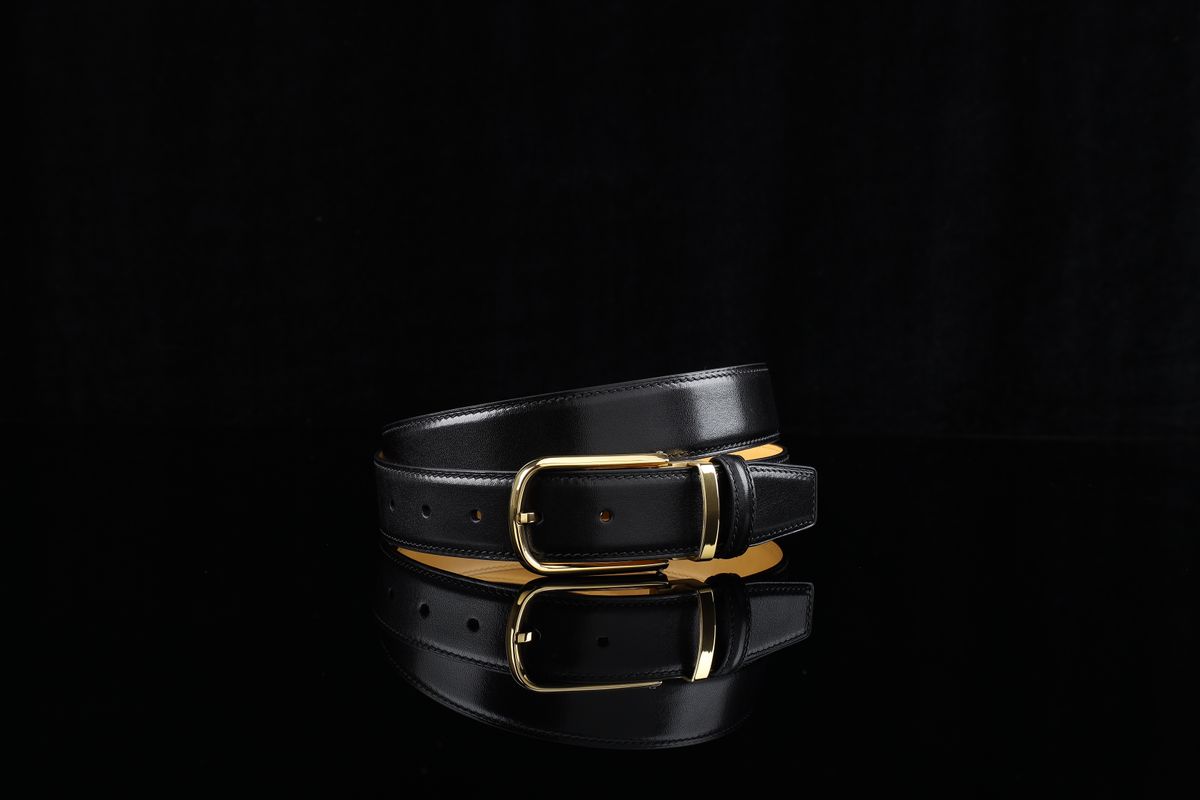
Meermin Black Bridle Belt 104137
The Hanks Everyday Belt is the disclosure benchmark: a single-piece strap sliced from 13-ounce North American steerhide, USA-tanned, 1.5 inches wide with dyed edges, finished with a Chicago-screw interchangeable buckle, sold at USD 89, and covered by a hundred-year warranty — every spec line a belt buyer needs appears on the listing. The Anson Black Buffalo strap is the value anchor at USD 28.99 for the strap: vegetable-tanned full-grain buffalo, trim-to-fit sizing up to a 50-inch pant, and the Micradjust ratchet buckle system in place of holes; it is sold as a strap plus optional buckle, and the 1.25-inch collection’s actual strap width runs slightly under its nominal 1.1875 inches. The Meermin Black Bridle Belt is the dress-side pick: an unlined 35 mm strap in vegetable-tanned Italian bridle leather with a stitched solid natural-brass buckle; the listing does not publish a price at the time of checking, and the page carries the shoemaker’s tannery-minded spec sheet — upper leather, lining, width, buckle metal — as a complete line-item set.
| Specification | Hanks The Everyday Belt | Anson Belt 1.25-Inch Black Buffalo Vegetable Tanned Leather Strap | Meermin Black Bridle Belt 104137 |
|---|---|---|---|
| Leather grade | Full-grain steerhide, single piece | Full-grain buffalo | Bridle leather (Italian, vegetable tanned) |
| Tanning | USA-tanned; method not stated | Vegetable tanned | Vegetable tanned |
| Stated weight | 13 oz hide | Not stated | Not stated |
| Width | 1.5 inches | 1.25 inches nominal (1.1875 inches actual) | 35 mm |
| Edges and lining | Dyed edges; 6 holes spaced 1 inch | Trim-to-fit raw end | Fully unlined |
| Buckle | Interchangeable via Chicago screws | Micradjust ratchet; buckle sold separately or bundled | Solid natural brass, stitched to the strap |
| Backing | 100-year warranty | Lifetime functionality guarantee | 30-day return policy |
The comparison shows the pattern this site keeps returning to: the makers who publish the awkward numbers — actual width, hide weight, tanning method — are the ones whose grade words can be trusted at face value, and the three-tier price spread here buys construction and disclosure rather than a better grade word. Anyone weighing leather terminology beyond belts — the grain versus suede distinction on shoes and jackets — will find the tannery vocabulary unpacked in the leather-versus-suede guide.
Sizing and caring for the strap
Belt sizing is measured from the buckle fold to the center hole, and makers disagree by one to two sizes on how far that lands from trouser size — the honest habit is to order by waist measurement against the maker’s own chart, not by trouser size alone. Trim-to-fit systems like Anson’s remove the guessing entirely at the cost of a one-time cut. On hardware, check the buckle attachment before the buckle style: Chicago screws let a worn buckle be replaced in minutes with a coin, while a stitched buckle on a bridle strap is a cobbler’s job, which is the deliberate trade a dress belt makes for a cleaner strap end.
Care follows the leather, not the accessory category. A vegetable-tanned strap wants occasional conditioning to keep the grain from drying and cracking, and nothing else — no saddle-soap routine, no waterproofing sprays on a dress belt. Chrome-tanned and heavily finished straps wipe clean with a damp cloth; their sealed surfaces need almost nothing until the finish itself ages. Hang the belt by the buckle rather than rolling it tightly at the crease, and keep it out of a hot car, where dashboard heat is the fastest way to warp a strap. The discipline of matching care to fiber and finish, rather than to garment type, is the same one behind the natural-versus-synthetic fiber map, and the same label-vocabulary habit pays off on any stitched leather good in your wardrobe.
The picks
Some links below are affiliate links — we may earn a commission at no extra cost to you.
Hanks The Everyday Belt
A single-piece strap sliced from 13-ounce full-grain USA steerhide with dyed edges and a Chicago-screw interchangeable buckle — the most complete published spec sheet in the category, backed by a 100-year warranty.
Anson Belt 1.25-Inch Black Buffalo Vegetable Tanned Leather Strap
Vegetable-tanned full-grain buffalo at USD 28.99 for the strap, with trim-to-fit sizing and a ratchet buckle system — the honest entry point into full-grain without paying for finishing flourishes.
Meermin Black Bridle Belt 104137
An unlined 35 mm strap in vegetable-tanned Italian bridle leather with a stitched solid brass buckle — the dress-width pick for buyers who want the strap itself, with no lining and no sealing, to age.
Comparison
| Specification | Hanks The Everyday Belt | Anson Belt 1.25-Inch Black Buffalo Vegetable Tanned Leather Strap | Meermin Black Bridle Belt 104137 |
|---|---|---|---|
| Leather grade | Full-grain steerhide, single piece | Full-grain buffalo | Bridle leather (Italian, vegetable tanned) |
| Tanning | USA-tanned; method not stated | Vegetable tanned | Vegetable tanned |
| Stated weight | 13 oz hide | Not stated | Not stated |
| Width | 1.5 inches | 1.25 inches nominal (1.1875 inches actual) | 35 mm |
| Edges and lining | Dyed edges; 6 holes spaced 1 inch | Trim-to-fit raw end | Fully unlined |
| Buckle | Interchangeable via Chicago screws | Micradjust ratchet; buckle sold separately or bundled | Solid natural brass, stitched to the strap |
| Backing | 100-year warranty | Lifetime functionality guarantee | 30-day return policy |
Specifications as published on the makers' product pages, checked November 2026.
Sources
- Hanks Belts product page for The Everyday Belt (hanksbelts.com) and its Amazon listing, for the 100% full-grain USA steerhide, single-piece 13 oz construction, 1.5-inch width with dyed edges, Chicago-screw interchangeable buckle, USD 89 price, and 100-year warranty, checked November 2026
- Anson Belt & Buckle product page for the 1.25-inch Black Buffalo Vegetable Tanned Leather Strap (ansonbelt.com), for the vegetable-tanned full-grain buffalo leather, trim-to-fit sizing to 50-inch pant, Micradjust ratchet system, actual strap width, and USD 28.99 strap price, checked November 2026
- Meermin product page for the Black Bridle Belt, style 104137 (meermin.com), for the vegetable-tanned Italian bridle leather, fully unlined 35 mm strap, stitched solid natural-brass buckle, and 30-day return policy, checked November 2026
Frequently asked questions
- Is full-grain leather always better than top-grain?
- For a belt that is meant to age, yes — full-grain keeps the intact outer grain, which is the strongest and densest part of the hide and the only layer that develops a genuine patina. Top-grain trades that surface for uniformity: the grain is sanded to remove blemishes, which removes some strength and most of the aging character in exchange for a flawless, consistent look.
- Does 'genuine leather' mean a bad belt?
- Not automatically. Legally the term only means the product contains real leather, but in trade practice it usually refers to the corium layers left after the top grain is split off, often sanded and embossed. A genuine-leather belt is real leather, but it is the weakest and least durable cut, which is why cheap belts crack and peel where full-grain ones bend and burnish.
- How thick should a good belt be?
- Dress belts typically run 3 to 4 millimeters, roughly 8 to 10 ounces of leather, so the strap rolls cleanly through trouser loops. Casual and work belts run heavier, from about 10 to 14 ounces, which gives stiffness for duty or carry use. Thickness alone is not quality — a poorly tanned thick strap is worse than a well-tanned thinner one — but a belt with no thickness disclosure at all is a warning sign.