Cotton scarf or wool scarf: a season table for scarf fibers

A scarf is the smallest garment with the largest seasonal range, and the fiber it is made from decides almost everything about when it can be worn. Cotton and wool sit at opposite ends of that range: cotton breathes, absorbs, and stays flat against skin in mild weather; wool traps air, resists moisture, and holds warmth in cold. Matching the fiber to the season — rather than to the outfit — is the whole decision.
Short answer
Cotton is the shoulder-season scarf: spring through autumn, and any indoor setting where wool overheats. Wool is the cold-season scarf: roughly below 10°C, over damp wind, and anywhere warmth per gram matters. If a single scarf has to cover a wide range, a fine merino knit in the middle weight band is the honest compromise; if the wardrobe allows two, cotton takes the mild half of the year and wool the cold half.
What the fiber decides before the season starts
Two properties split cotton from wool, and both come from the fiber itself rather than the knit. The first is moisture behavior: cotton absorbs water readily and holds it, which is why a cotton scarf goes clammy in rain and stays cold; wool absorbs up to roughly a third of its weight in moisture while still feeling dry, and generates a little heat as it absorbs. The second is trapped air: a wool knit’s slightly fuzzy, elastic structure holds still air in the same thickness where a smooth cotton weave holds less, so wool insulates at weights cotton cannot match.
Everything practical — weight choice, care, even drape — follows from those two facts. A season table makes the mapping concrete:
| Fiber | Comfort window | Character on the neck | Watch out for |
|---|---|---|---|
| Cotton | Mild spring to autumn; indoor use | Flat, cool, matte, absorbs sweat | Clammy when wet; little warmth |
| Merino wool | Autumn through spring | Soft, fine, lightly springy | Pilling on cheap short-staple knits |
| Lambswool | Late autumn to deep winter | Loftier, warmer, slightly pricier feel | Prickle against bare skin |
| Cashmere | All winter; indoor evenings | Featherweight, very soft | Delicate; needs careful storage |
| Silk | Spring and early autumn; evening layer | Smooth, luminous, low bulk | Almost no insulation |
Cotton: the shoulder-season scarf
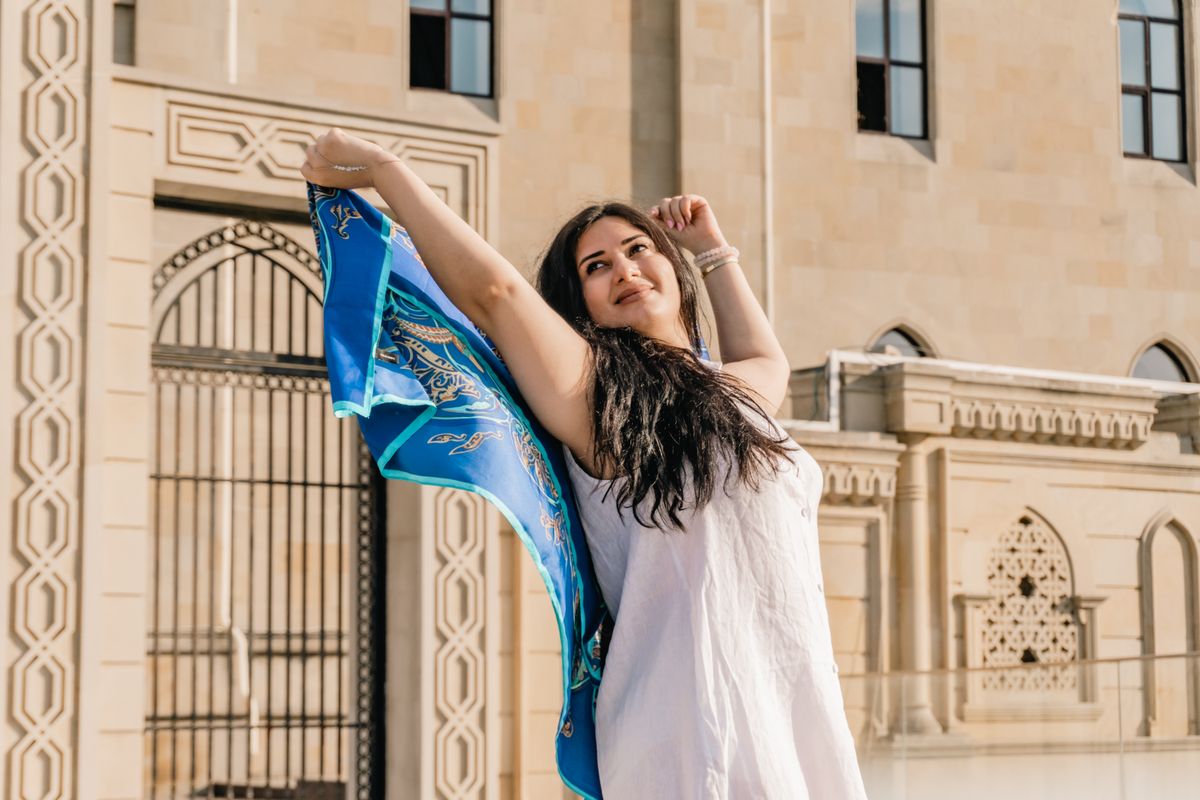
Cotton earns its place between the seasons. In weather from roughly 12 to 22°C, the neck is the body’s thermostat — bare in a breeze and you feel a chill, wrapped in heavy wool and you overheat — and a cotton scarf sits exactly in that gap. It drapes flat, takes saturated color well in printed and woven designs, absorbs sweat without smelling, and washes like laundry with no special handling.
The same absorbency is the winter disqualifier. Cotton holds moisture against the skin, and a damp cotton scarf in cold wind pulls heat out of the neck instead of trapping it — a genuine downside, not a taste issue. For the same reason, cotton is the indoor scarf: in offices, trains, and restaurants where a wool scarf becomes unbearable within minutes, cotton breathes through.
Weight matters within cotton, just in a narrow band. Woven cotton scarves — voile, chambray, lightweight twill — sit at the light end and are mostly about drape and coverage; knitted cotton runs slightly heavier and warmer but sags over a season, because cotton has little elastic recovery and stretches permanently under its own weight.
Wool: the cold-season scarf
Wool takes over when temperatures fall and moisture enters the picture. The fiber’s crimp — the natural wave in each strand — keeps the knit lofty, and loft is trapped air, which is insulation. Damp wind that defeats cotton barely registers: wool keeps insulating while wet, which is why wool scarves suit rain and sea air and why walkers never pack cotton for cold climates.
The wool shelf spans a micron range that changes how the scarf feels, and the scale is worth knowing before buying:
| Wool type | Typical fiber fineness | Feel on the neck |
|---|---|---|
| Fine merino | roughly 15.5-19 microns | Soft against bare skin |
| Mid-micron merino | roughly 20-23 microns | Comfortable; sensitive skin notices |
| Lambswool | roughly mid-20s microns | Warm, loftier; usually wants a collar barrier |
| Coarse wool blends | 25+ microns | Outer layer only; pricky |
The micron logic mirrors the rest of wool clothing — the finer the fiber, the closer to bare skin it can go — and the full scale, including why finer fibers bend rather than poke, is explained in the merino micron guide. Cashmere, finer still at roughly 14 to 19 microns, is the luxury end of the same spectrum: the warmest fiber per gram on the shelf, and the most delicate.
The season table: matching fiber to weather
The whole argument compresses into one table, which is worth saving as a reference:
| Condition | First choice | Second choice | Avoid |
|---|---|---|---|
| Mild spring, 12-18°C | Cotton | Fine merino | Lambswool, cashmere |
| Warm summer evenings | Cotton, thin weave | Silk | Any wool |
| Cool autumn, 8-15°C | Fine merino | Cotton knit | Coarse wool |
| Cold winter, below 8°C | Wool or cashmere | Heavy merino knit | Cotton |
| Cold rain or sea wind | Wool | — | Cotton |
| Indoor offices and transit | Cotton or silk | Fine merino | Lambswool |
Two patterns sit inside the table. First, wool’s window opens below roughly 10-12°C and closes above it; cotton occupies everything else. Second, dampness is a tiebreaker: any weather with real moisture in the air moves the choice toward wool regardless of temperature.
Weight in grams per square meter
Scarf listings rarely state fabric weight, but when they do, the numbers sort the shelf cleanly. Scarf-weight fabrics run roughly 100 to 400 gsm: voile and thin cotton weaves under 120 gsm; midweight cotton and fine merino knits around 150-250 gsm; lambswool and heavy knits 300 gsm and up. The full framework, from shirting to canvas, is mapped in the GSM fabric weight guide, and the same bands apply to scarves with the logic reversed from garments — since a scarf is pure insulation and drape, weight is the feature rather than the cost.
When a listing omits weight, thickness in the hand substitutes: a scarf that compresses flat in the fist is in the light band; one that springs back after compression carries enough air to insulate.
Care differences that decide lifespan
Cotton is the low-maintenance fiber: machine wash, ordinary detergent, tumble dry if the label allows, and the scarf returns. Wool needs the gentler cycle — cool water, wool detergent, flat drying — because heat and agitation felt the fiber into a smaller, stiffer scarf. Between washes, wool manages itself: odor resistance means airing usually replaces laundering entirely, and a wool scarf worn daily may need two washes a season.
Storage separates the fibers too. Cotton scarves fold into a drawer indefinitely; wool scarves need off-season protection from moths, in sealed storage with the usual wool precautions. Cashmere adds the strictest rule of all — stored clean, folded, never hung, since hanging stretches the softest fiber permanently.
Where silk and blends fit
Silk closes the triangle. It has the lowest bulk and insulation of the three, which makes it the dress scarf: smooth against a coat collar, luminous in color, and structured enough to tie. Silk scarves are graded by momme weight rather than GSM, and the grading system is laid out in the silk momme guide.
Blends blur the boundaries on purpose. A cotton-wool blend softens wool’s prickle and eases washing; a wool-silk blend adds drape and sheen to warmth; acrylic-wool blends cut cost at the expense of breathability, and read the fiber line before paying for one. The blend percentages are stated on every honest label, and they carry more information than the fabric’s name does.
Frequently asked questions
- Can I wear a cotton scarf in winter?
- As an indoor layer or on mild winter days, yes — cotton still blocks some wind and holds a little air. But cotton loses insulating ability when it absorbs moisture, so in cold, damp, or windy conditions a wool scarf holds warmth where a wet cotton scarf actively chills the neck.
- Which scarf material does not itch?
- Cotton and silk never itch, since they lack the coarse scales of thicker wool fibers. Among wools, merino at 19 microns or finer feels soft on the neck for most people, while lambswool and coarser knits usually need a shirt collar or a cotton or silk lining between the knit and bare skin.
- Are cashmere scarves warmer than wool scarves?
- Cashmere insulates better gram for gram because its finer fibers trap more air in the same thickness, so a light cashmere scarf can feel warmer than a heavier lambswool one. Warmth still scales mostly with thickness and trapped air, so a chunky wool scarf will out-warm a thin cashmere one regardless of fiber.