Reading fabric information on a product page: what listings actually tell you
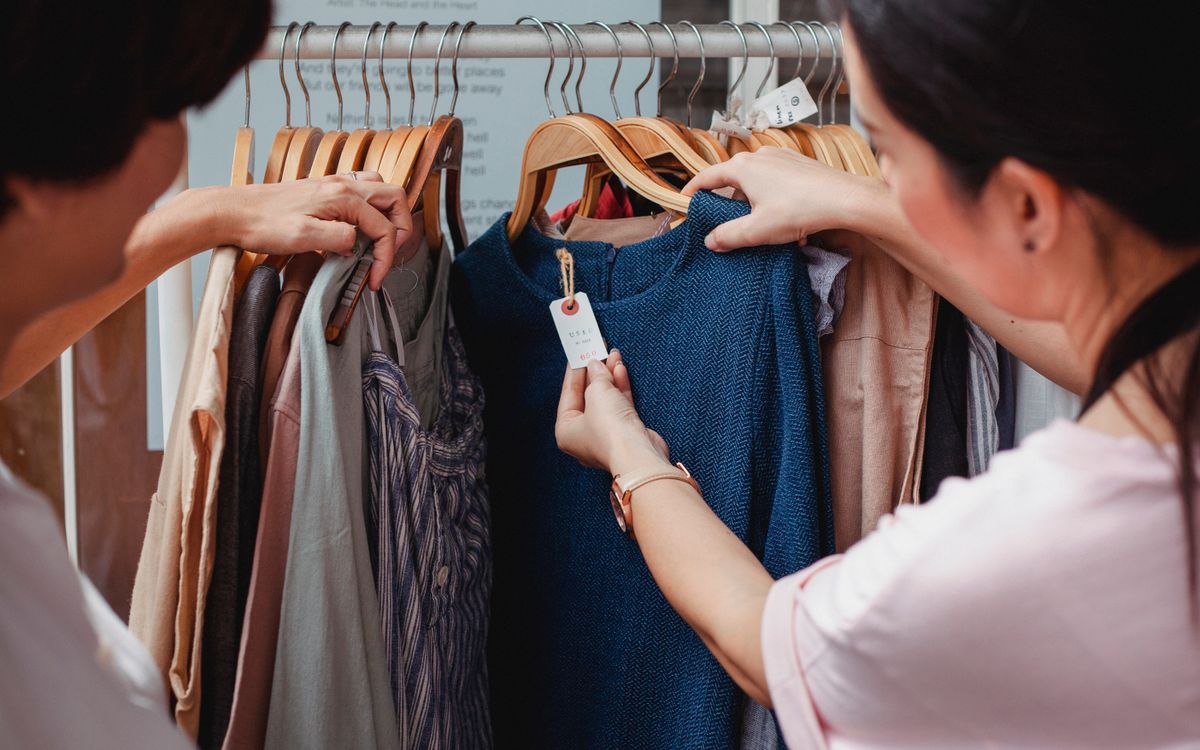
Buying clothes online removes the two checks a fabric store gives for free: touching the cloth and reading the bolt label. A product page replaces them with a spec line, some photos, and a size chart — and each of those encodes more fabric information than most listings surface. Reading them in the right order turns a product page from a marketing pitch into a materials document.
Short answer
Read a product page in this order: composition with percentages first (it predicts care and season), weight in gsm or oz second (it predicts feel and opacity), weave or knit name third (it predicts texture and aging). Then use the photos as physical evidence — hem thickness, drape on the model, texture close-ups — and the size chart as drape data. Adjectives like “premium” and “luxurious” carry no information; what is missing from the spec line usually matters more than what is in it.
The hierarchy of listing evidence
Product pages present information in a designed order — photos, adjectives, then specs — but the reliable order is the reverse. Specs are the only part of a listing with fixed meanings; the rest is presentation.
The evidence hierarchy, strongest first:
- Composition with percentages. “100% organic cotton” is a fact; “cotton-rich blend” is not. Exact percentages predict shrinkage, care requirements, warmth, and moisture behavior.
- Fabric weight. A number in gsm or oz/yd² is the single best predictor of how a garment feels and drapes. Its presence alone signals a brand that measures its cloth.
- Weave or knit name. Poplin, twill, oxford, jersey, interlock — each name carries a construction the buyer can verify against reference descriptions.
- Photos of the physical garment. Evidence, but evidence that can be styled: steam, pins, and post-production all alter how cloth reads.
- Adjectives. “Premium”, “buttery-soft”, “quality fabric” — no verifiable content, safe to ignore entirely.
A listing that provides the first three is doing better than most; a listing that provides none of them and leans on the fifth is asking the buyer to buy blind. The physical-label equivalent of this hierarchy, for when the garment arrives, is covered in the fabric label decode.
Composition lines and what the percentages hide
Composition is the most quoted spec and the least read. The percentage split carries several predictions at once:
| Composition line | What it predicts | Common trap |
|---|---|---|
| 100% cotton | Breathable, washable, shrinks 3-5% unwashed; wrinkles | Not all cotton is equal — staple length is unstated |
| 100% linen | Cool, creases permanently, softens for years | “Linen feel” or “linen look” is usually viscose or poly |
| 95-98% cotton + elastane | Recovery in fitted cuts; slightly warmer feel | Elastane degrades with heat; no high-heat drying |
| Cotton-poly blend | Faster drying, fewer wrinkles, less breathable | Ratio often unstated; “cotton feel” claims poly dominance |
| Viscose / rayon | Drapes well, cool hand, weak when wet | Shrinks and water-spots; often needs gentle care |
| Merino or wool, % unstated | “Wool” alone can mean as little as a trace | Look for a stated percentage or micron rating |
Two reading habits catch most deceptions. First, watch for fiber names used as textures rather than materials: “linen feel”, “suede”, “vegan silk” describe hand, not composition, and the actual fiber sits in the small print. Second, treat vague blends as a choice the brand declined to make transparent — an honest blend states its ratio, because the ratio is the point of blending. When a wool knit states its micron count alongside the percentage, that is the strongest composition line in knitwear, because fineness — not the word “wool” — is what predicts softness and pilling behavior.
Weight claims: present, converted, or absent
When a listing states weight, it has already done most of the work. The reading rules:
- gsm and oz are the same measurement. Oz/yd² multiplied by 33.9 gives gsm. A “5 oz tee” is about 170 gsm; a “6.5 oz” is about 220 gsm. American-leaning brands print ounces; European and Asian brands print gsm.
- Knits and wovens are not comparable at equal weight. A 200 gsm jersey and a 200 gsm oxford are different garments; weight comparisons are valid within a construction type.
- Absence is information. Brands that know their cloth state the number, because it flatters them. Its absence does not prove anything bad, but it removes the fastest route to predicting feel, and it shifts more weight onto the photos.
When weight is missing, the fallback chain runs: ounces, then weave name, then photo evidence. A stated weave name does real work here — a “poplin” shirt reads light and smooth, a “brushed twill” reads midweight and soft — provided the name is used honestly, which is also why learned weave vocabulary is the second most valuable thing a buyer can carry to a product page.
Photos as fabric evidence
Product photography can lie, but it lies in specific directions, and knowing them recovers most of the truth. The highest-value photo is the close-up: texture shots at the weave level show yarn character, knit density, and finishing that no spec line captures. If a listing offers no close-up, the model shots still give three readings:
- Drape. How the cloth breaks at the elbow and knee reveals weight and stiffness. Cloth that holds flared shapes is stiff or heavily sized; cloth that folds in soft rolls is light or supple.
- Opacity. Light-colored garments photographed against bright light betray thin cloth — visible outlines or layering through the fabric are the tell.
- Surface. A visible heather, slub, or rib texture indicates yarn character; a perfectly flat, slightly shiny surface on a “cotton” garment suggests a poly blend or heavy sizing.
The honest comparison: photos show the garment at its best moment, brand new and professionally styled. Fabric quality is mostly a statement about the garment at year two. Photos can confirm the composition and weight story; they cannot confirm aging behavior, which is where the weave name and fiber percentages do their work.
The size chart is fabric information
Buyers read size charts for fit; they are also reading cloth. A size chart with a stretch note (“fabric has 2-way stretch”, “relaxed fit through the body”) is admitting the garment relies on elastane or a loose cut. Measurements themselves reveal the cut’s dependence on fabric behavior: a shirt whose chest measurement is barely larger than the body it fits must be knit or heavily elastaned to work, while a woven shirt sized with 10-20 cm of ease depends on drape rather than stretch.
Three chart readings worth doing:
- Ease amount. Small ease in a woven garment means stiff cloth will pull; generous ease hides heavy cloth. Both work, but the failure modes differ.
- Fit notes versus composition. A “relaxed fit” note on a 100% rigid cotton garment predicts a boxy, structured result; the same note on a viscose blend predicts fluid drape.
- Model sizing. “Model is 180 cm and wears size M” combined with the chart tells whether the cloth runs large — oversized results usually mean either a true oversized cut or limp, drapey cloth.
The silences that matter
The final reading skill is negative: noticing what a well-specified listing includes that a weak one omits. The most consequential silences, in rough order of cost:
| Silence | Probable reality | Risk level |
|---|---|---|
| No composition percentage | Blend with a dominant undisclosed fiber | High for care and season |
| No weight, no ounces | Feel and opacity unknown until arrival | Moderate — often just a weak listing |
| No weave or knit name | Construction unknown; texture unpredictable | Moderate |
| No care instructions | Difficult-care fabric left unexplained | High for silk, wool, viscose |
| No country of origin | Unusual — most markets require it | Low for fabric, but a credibility marker |
None of these silences is a verdict by itself. Together they form a profile: a listing that states composition to the percentage, prints gsm, names the weave, and includes care symbols belongs to a brand that treats fabric as a spec, and its claims can be taken at face value. A listing that says “premium quality fabric” while omitting all four is asking the buyer to price the adjectives. The systematic version of this check — five spec lines to verify before any order — is laid out in the pre-purchase spec check, and for garments that do arrive with a full spec sheet, the same skill applies to judging whether the price tracks the cloth, which the price-versus-quality analysis examines in detail.
Frequently asked questions
- What fabric information matters most on a product page?
- In order: fiber composition with percentages, fabric weight (gsm or oz), and weave or knit name. Composition predicts care and season, weight predicts feel and drape, and the weave name predicts texture and how the cloth ages. Everything else — marketing adjectives, model shots — is secondary evidence.
- Is 100% cotton always better than a blend?
- No. Blends exist to fix specific weaknesses: a few percent elastane gives recovery in fitted garments, polyester in a cotton blend speeds drying and reduces wrinkles. What matters is why the blend is there. An undisclosed blend ratio, or elastane used to compensate for a poor cut, is the actual warning sign.
- What if a listing gives no fabric weight at all?
- Estimate from secondary clues: the ounce conversion if ounces are stated, the weave name (an oxford reads heavier than a voile at the same fiber), close-up photos showing fabric thickness at the hem, and the size chart's measurements. If none of these appear, treat the garment's feel as unknown rather than guessing from the price.